
A Story of Self Defense and Survival During the 1992 LA Riots
In the aftermath of the 1992 Los Angeles riots, an iconic image emerged from the chaos: Korean American business owners standing on the rooftops of their stores, armed and ready to defend their livelihoods. These individuals would come to be known as the “Rooftop Koreans,” a term that’s since taken on cultural and political significance far beyond the events immediately connected with it.
From Protest to Civil Unrest – The Verdict That Shook a City

The LA riots, which lasted from April 29 to May 4, 1992, were sparked by the acquittal of four LAPD officers involved in the brutal beating of Rodney King, an African American motorist. The verdict triggered long-standing tensions related to racial inequality, police brutality, and socioeconomic disparity, culminating in widespread protests, looting, vandalism, arson, and violence across Los Angeles.
As the chaos erupted, Korean American-owned businesses, especially in Koreatown, were disproportionately targeted. With the LAPD overstretched and slow to respond in certain neighborhoods, Korean American shopkeepers found themselves isolated and vulnerable.
Koreatown in the Crossfire – A Community Left to Fend for Itself

Koreatown, located west of Downtown Los Angeles, had become a thriving enclave for Korean immigrants by the early 1990s. Many Korean Americans owned small businesses such as convenience stores, liquor stores, and laundromats, often in predominantly Black or Latino neighborhoods where racial tensions sometimes festered.
When the riots broke out, Korean American business owners called for police protection, but law enforcement primarily prioritized safeguarding wealthy neighborhoods such as Beverly Hills and Fairfax. As the looting and violence spilled over into Koreatown, business owners were left to fend for themselves.
The Rise of the Rooftop Koreans – A Legend Is Born

In response, Korean American shopkeepers, many of whom were veterans of South Korea’s mandatory military service, took up arms. They organized neighborhood patrols, set up barricades, and, in many cases, climbed to the rooftops of their stores with rifles to deter looters. Media coverage of their actions quickly turned them into iconic symbols of self-defense and resistance.
These Rooftop Koreans became a striking embodiment of the American ideal of self-defense. To some, they represented courage and defiance in the face of abandonment. To others, their actions raised questions about the role of race, vigilante justice, and gun culture in America.
Aftermath and Legacy – A Community That Refused to Be Forgotten

The 1992 LA riots resulted in more than 60 deaths, over 2,000 injuries, and an estimated $1 billion in property damage. At least 2,300 Korean American-owned businesses were damaged or destroyed. The Korean American community, feeling invisible in both mainstream media and political discourse, began to mobilize more actively in civic life in the following years.
The Rooftop Koreans have since become an iconic symbol in American culture, often sparking conversation around gun rights, self-defense, and race relations. Celebrated by some and questioned by others, their actions reflect deep complexities within society. What remains certain is the profound impact they had on the American consciousness. Their legacy is one of courage, strength, and a community’s unwavering resolve to defend itself after law enforcement and city officials turned their backs on it. Theirs is a compelling story of self-defense and survival that continues to resonate more than 30 years after the 1992 LA riots.
Return of the Rooftop Koreans – Imagining the Rooftop Koreans Today
Return of the Rooftop Koreans is a fictional story that imagines the return of a new generation of Rooftop Koreans, standing up to protect their community in the present day. Inspired by the courage and resilience of Korean American business owners during the 1992 LA riots, this story explores how that spirit might surface today.
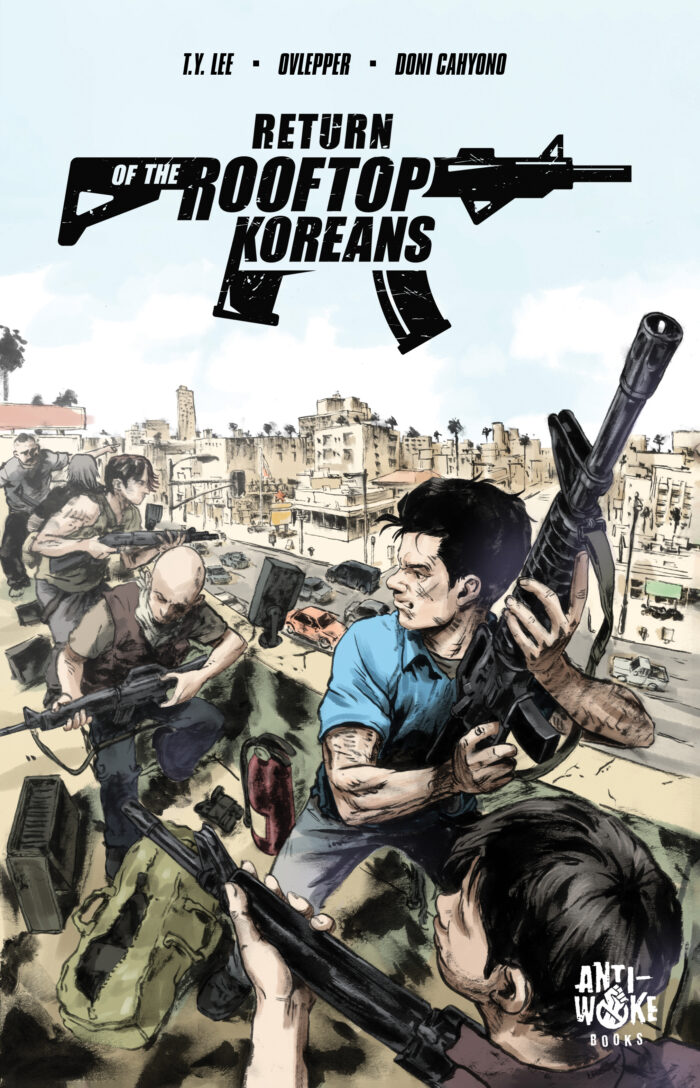
Return of the Rooftop Koreans – Cover A
Rooftop Koreans is a 148 page (117 Story Pages + Bonus Content), full-color graphic novel about a new generation of Rooftop Koreans who take up arms to protect their community in the face of chaos and injustice. Drawing inspiration from the real-life Rooftop Koreans of the 1992 LA Riots, Return of the Rooftop Koreans is a…